Tuesday, October 14, 2025
Maurice Goldfoot's Silver Falls Wholesale Meats' And His Father, Nathan's Trek to Portland, Oregon
Nadene Goldfoot
Maurice Goldfoot's cattle truck, running from Ontario, Oregon's Goldfoot's feed lot to his Silver Falls Meat Packing Co. on Columbia Blvd. Maurice's father was Nathan Goldfus/Goldfoot of Portland, b: 1869 in Telsiai, Lithuania and d: Portland, Oregon July 19, 1912 in a horse and wagon accident. He was
Nathan "Nokhim Avram"Abraham" Goldfus/Goldfoot. Maurice's only son was David Alan Goldfoot, PhD, psychologist, practicing in Wisconsin and Texas.
.
Several factors fostered the acceptance of Jews suggested by these political achievements. The timing and composition of Jewish migration was key. Jews first arrived in Oregon in 1849, just years after the first Overland immigrations brought resettlers to the region. The vast majority, like Goldsmith and Wasserman, were immigrants from German lands; but rather than coming directly to Oregon from Europe, most spent years elsewhere in the United States before following the Gold Rush west and establishing merchandising networks anchored in San Francisco and extending north to Oregon. Those who settled in Oregon brought with them knowledge of English, familiarity with frontier society, and connections to San Francisco-based trade networks that positioned them well to join with fellow pioneers and help create new communities.
In 1869, Bernard Goldsmith, an immigrant Jew from Bavaria, was sworn in as the mayor of Portland. Two years later, he was succeeded in office by his friend, countryman, and coreligionist, Philip Wasserman, a former state legislator who would later serve on the city’s school board. Jews comprised only about 0.5 percent of Oregon’s population in the late nineteenth century, yet Goldsmith's and Wasserman’s political achievements were hardly unusual. At least seven Jewish mayors served towns across the state, and others held statewide office, served in the legislature, and sat on city councils and school boards. Between 1877 and 1911, Joseph Simon, a German Jew, served on Portland’s city council, in the state senate, in the U.S. Senate, and as Portland’s mayor.
-There is no indication of any other name for Moshe in the Lithuanian records, though he surely had one. Chaim Yitzchak is totally different than Moshe. It seems unlikely to me that this could be the same person. It is possible that Nathan's widow mis-recalled the name of her father-in-law, whom she presumably did not meet (though she was also a Litvak, so perhaps the families knew each other), but this is unlikely. This discrepancy is really mysterious. I spent a little time researching a family with the name Goldoft/Goldovis from Merkine. There was a Nokhim, born around 1870, whose father was Itsko and there was an earlier Khaim, so this Itsko could have been Chaim Yitzchak. But the relationship would be too distant from the Dublin family for you to have confirmed a 3rd cousin relationship, so this situates your grandfather within the Dublin family.
12/5/08 "Nathan' Not listed on ancestry.com UK incoming passengers 1878-1960, though many other Goldfoots are in there. http://tinyurl.com/668qq5.
3/2/17: Not listed on "Maryland, Baltimore Passenger Lists, 1820-1948.
Died at age 39 years 11 months 14 days in horse and wagon accident in Portland, Oregon.
4/13/11 Feb 21, 1893 married in Dublin, Ireland. By June 14, 1893 was on ship headed for Winnipeg listed as single.
Winston Churchill was born in 1874, and
Nathan Goldfoot b: 15 August 1871 in possibly Telsiai, Lithuania or Ukraine, Russia and died 19 July 1912 in Portland, Oregon.at age 43.
Nathan is found on the www.findmypast.com list having left Liverpool, England, Londonderry (Irish port) bound for Quebec and Montreal in 1893 at the age of 22. If the age is correct, he was born in 1871 and not 1874 as I have thought.
Nathan was born at the worst period in Russian history. The 1880's was another dark period of rising anti-Semitism, expulsions from large cities and many other general restrictions. It was mandatory for Jews "to keep the same names that had been entered in the vital records." 1881 saw Alexander II assassinated causing antisemitism. Jews were traders and artisans since Middle Ages and were now restricted in Russia including much of Poland. in Pale of Jewish Settlement. Serfdom was in Russia until 1861. In 1891 22,000 Jews in chains led from Moscow and St. Petersburg to the Pale.
It was hard to leave Russia. They had to cross borders illegally into Austria/Hungary, then to Vienna or Berlin. In Hamberg, Bremen and Rotterdam, thousands tried to find passage to America, standing in long lines. Then they crowded into steerage for 2 to 4 weeks of seasickness and hundreds sharing a toilet. In 1904 20,000 people did not pass the inspection and were sent back to Europe. Between 1881 and 1910 1.5 million Jews emmigrated to USA. Of that 1 million were from Russia. Most Eastern European immigrants destined for Oregon stopped on the Lower East Side before traveling by train across the country to Portland. Others came more directly because relatives or families had already settled here.
Pograms in Russia=age 9
May Laws of Jewish Discrimination, age 10
Grandfather Nathan "Nahum" came over to the U.S.A in 1896 ? when he was 24 years old.(according to census information or death certificate. He died at age 40 years 11 months 4 days. That would be two years after being in Quebec.
He was born on August 5 or 15, 1871 according to www.findmypast or 1874 on a Saturday. It is possible he was born in Telsiai, Lithuania, commonly referred to as "Russia."
According to the Goldfoot family in South Africa, they came from the Ukraine in Russia. On the 1910 census he said he was born in 1872. When he died, his wife was not told about the accident as it was Shabbas. She learned about it later. He had money hidden, and she never learned where it was.
Lithuania lies in the eastern Europe, on the coast of the Baltic Sea. In the north Lithuania borders with Latvia, in the east and south with Byelorussia, in the south-west with Poland and with the Kaliningrad region of the Russian Federation.
12/20/08 I found him in Quebec arriving in 1893 on ship Parisian. Reference RG76; microfilm C-4539. He contracted to get off at Winnipeg. He was number 29520 on the ship of 8 men and 2 women passengers. Parisian was the 1st large steamer of the Allen Line taking immigrants to Canada. It weighed 5,359 tons and sailed first on May 1881. It took 13 1/4 days from Liverpool, England to Canada and took 18 days from Glasgow, Scotland.
His name, Nathan, and Natan is a Jewish name from the ten Polish Provinces of Kalisz, Kielee, Lomza, Lublin, Pietrkow, Plock, Radom, Siedlce, Suwalki, and Warsaw. Poland was partitioned in 1772, 1792 and 1795. Then it was part of Russia. Nathan must be the anglicized name.
Naum\Nakhim\(Nahum 1:1) Variants: Nakhim (L), Nokhim (L,P,V), Nokhum (L), Nukkhem, Nukhim (P,V) Nukhimche(P). (L )means Lithuania, present-day Lithuania and northern Belarus. (P) means Poland, the 10 Polish provinces, and (V) Volhyn, present day Zhitomir, Rovno, Luts'k and Volyn regions.
Some earlier history causing the Pale of Settlement where Lithuania was :
On  December  23,  1791,  Empress  Catherine  of  Russia
issued  a decree  restricting  Jewish  habitation  to  specific
 areas.
This  decree  applied  to  White  Russia  (Byelorussia),  the
Ukraine  and  other  areas  taken  in  the  partition.  After
the Third
Partition,  the  decree  was  extended  to  include  the  newly
acquired  territories  along  the  Baltic  Sea.  Thus  was  born
 the
Pale  of  Settlement,  the  area  where  Jews  were  allowed  to
  live;
an  area  that  stretched  from  the  Baltic  to  the  Black  Seas
.

Of  the  areas  then  inhabited  by  Lithuanian  Jewry,  ethnic
Lithuania  and  Byelorussia  became  an  integral  part  of
 Russia
and  the  southerm  part,  around  Grodno  and  Suwalk,  became
part  of  the  Duchy  of  Warsaw  (Poland).  Although  Lithuania
may  have  been  divided,  the  Jewish  Litvak  community
remained  integrated  until  World  War  I.

It  has  been  estimated  that,  at  the  time  of  partition,
 25
percent  of  all  the  Jews  of  easterm  Europe  were  Litvak
Resource:
My notes through the years from other genealogists
Labels: Dublin, Ireland, Jews of Portland, Lithuania, Russia, South Africa
Friday, June 30, 2023
Early Wars Causing Lithuanian Jews to Flee to Ukraine
Nadene Goldfoot
In 1432 -1438 there was war in Lithuania. It was Lithuania and Poland against Russia.
From 1487-1494 a 2nd war was fought; the Lithuanian Muscovite War of Lithuania, the Golden Horde against Moscow.
From 1492-1537, the war raged on as the Muscovite-Lithuanian wars of Lithuania and Moscow. (1492 when Columbus sailed the ocean blue) and Jews had to leave Spain, start moving all over trying to find a home...
By 1495, Jews were living in Vilna, Grodno and Kovno totaling 10,000.
1508 was the Glinski Rebellion against Lithuania by Glinski supporters
1524 was the big Ottoman-Tartar invasion of Lithuania and Poland
1561to 1570 was the Northern 7 Years War of Lithuania/Poland against Sweden
They received a charter in 1529 guaranteeing freedom of movement and employment. Soon they were the leading workers in foreign trade and taxing and farming. However, from 1495-1502, the first 7 years of being in Lithuania, they were excluded FROM Lithuania. In 1566-1572, the Jewish badge was introduced for Jews to wear to distinguish themselves from citizens. Jews were disqualified in the court system for giving evidence.
1576 to 1582 was the Livonian War of everyone (Lithuania/Poland/Sweden, Norway, Denmark, Transylvania); being against Tsardom of Russia
1600-1629 was again the Polish-Lithuanian Commonwealth and Swedish War and 1605-1618 included war against Russia and 1606 -1608 the Zebrzydowski Rebellion of nobles against the king.
Organization took place. Jews were represented in the COUNCIL OF THE FOUR (then 5) LANDS, but that wasn't helping, so the Jews formed a separate COUNCIL OF LITHUANIA in 1623 when a separate tax-system was established.
Catherine II in the 1780'sBy 1762, Catherine II permitted all aliens to live in Russia, except Jews. Partitions of Poland, resulting from wars, took place in 1772, 1793, and 1795, when the large group of White Russian Jews, Ukraine, Lithuania and Courland became Russian subjects. For more than a century, they were all under the reactionary rule of the Czars.
Lithuania became part of Russia in 1795 which lasted until WWI of 1918. It had become a major part of the Jewish culture so was most important. It was the home of distinguished yeshivote (Jewish schools) and leading rabbis such as the Gaon of Vilna. It became the seat of MUSAR movement, and a center of Haskalah.
During World War I, 100,000 Jews were expelled or actually emigrated to the Russian interior, leaving their shtetles. In independent Lithuania, Jews received national autonomy from 1918- 1924. A Jewish National Council was established under a Ministry for Jewish Affairs. They had the right to levy taxation under government auspices.
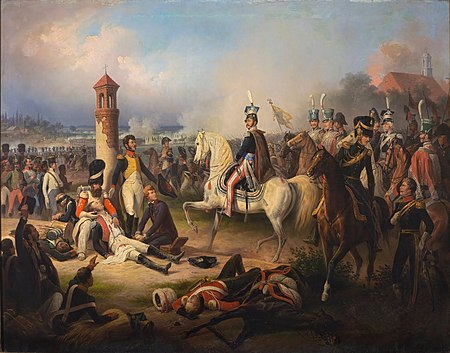 Polish forces stops Austrian advance at Raszyn, only to retreat to the other side of the river soon afterwards.
The Austro-Polish War or Polish-Austrian War was a part of the War of the Fifth Coalition in 14 April 1809 (a coalition of the Austrian Empire and the United Kingdom against Napoleon's French Empire and Bavaria). It ended October 14, 1809. It lasted 6 months.
Gaon of Vilna, Rabbi EleazarVilna, the largest city as well as capital, was lost to Poland in 1919, the result of WWI. This weakened the Jews of Vilna. After 1924, autonomy was restricted solely to religious matters, while the economic position of the Jews deteriorated in the oncoming years.
No Jews survived the expulsion of Jews of 1290 when Jews were also expulsed from England. A few former Marranos settled in Dublin after 1660 and more arrived as military purveyors after the 1689 revolution. Original Jews were displaced by Ashkenazim, but by 18th century, population declined and by 1816 there were only 3 Jewish families in Dublin and a few in other Irish towns. They were joined by others in 1822 and the population was 400 by 1880. Emigration from Eastern Europe took place at the end of the 19th century and many went to Dublin, Cork, Waterford, Limerick, Belfast. the chief rabbinate was founded in 1918 being Yitzhak Halevi Herzog with the Jewish population in 1990 at 1,600, mainly in Dublin,
Many Jews of Lithuania moved on to Dublin, Ireland and from there, to South Africa which Jews started settling in the early 19th century. Capetown had a synagogue by 1841. The settlers were traders and peddlers who traveled among the Boer farmers. Later they went to the towns. Gold was discovered there in the end of the 19th century, which eastern European Jews which drew many. Johannesburg became the main Jewish settlement, and they enjoyed the political equality in Cape Colony and Natal, but obtained it in the Transvaal only after the 2nd Boer War. Immigration to South Africa was popular following WWI and came mostly from Lithuania.

I know that Simon Goldfoot moved from Lithuania to South Africa in the 20's. His son, Stanley Goldfoot b: May 2, 1914, was born there in Houghton, Johannesburg, South Africa. Immediately after graduation high school, he made Aliyah to Palestine, and he lived in Jerusalem, becoming the Chief of Intelligence for the Stern Group which the British called the Stern Gang.

Polish–Lithuanian Conflict) was an undeclared war between newly independent Lithuania and Poland following World War I, which happened mainly, but not only, in the Vilnius and Suwałki regions. The war is viewed differently by the respective sides. According to Lithuanian historians, it was part of the Lithuanian Wars of Independence and lasted from May 1919 to 29 November 1920. Polish historians deem the Polish–Lithuanian war as occurring only in September–October 1920. Since the spring of 1920, the conflict became part of the wider Polish–Soviet War and was largely shaped by its progress. It was subject to international mediation at the Conference of Ambassadors and the League of Nations.
Though most emigration from Lithuania went to Israel, it is now going to other English-speaking countries. The rabbis of the principal congregations in Johannesburg (Jewish population was 63,620. Cape Town of which Cape Peninsula had 28,000. Chief rabbis and 65 synagogues are affiliated to the Orthodox Federation of Synagogues. A Reform Movement started in 1933 and has 14 affiliated congregations. Also, there are 69 nursery schools, 10 primary schools and 8 high schools. They have an extensive Jewish press and a lot of cultural activities. By 1990 there were 120,000 Jews living in South Africa.
In 1923, there were 300 Jewish elementary schools, the majority teaching in Hebrew, a minority in Yiddish (Hebrew-German Combo).
Jews of Central Europe in the 14th and 15th centuries immigrated to Ukraine and from Poland in the 16th to 17th centuries. Severe massacres happened during the Chmielnicki and the Haidamak uprising in the 17th to 18th centuries.
The Frankist and Hasidic movements originated in the 18th century in Ukraine which was also associated with the early Zionism in the 19th-20th centuries. Jews of Galicia and White Russia had emigrated there.
The Soviet Government promoted Jewish settlement in the Ukraine in the 1920's, however. They used the funds of the American Joint Distribution Committee in the regions of Kalinindorf, Zlatopol, and Stalindorf. By 1930 there were 90,000 Jewish agriculturists there. In January 1918 , a regime of national autonomy was estalished in the Ukraine. Jewish economy and culture suffered under Soviet rule. About half of Soviet Russia's 3 million Jews lived there before WWII. Under Nazi rule, the Jewish people who had not fled to Russia were wiped out by the Germans and Ukrainians from 1941 to 1942. The Jewish population was officially put at 777,126 in 1970 and at 484,129 in 1989.
There were restrictions on them imposed during the 1930's limited the influx (when Germany and Nazism were affecting all countries towards Jews), although many German Jews were able to settle in South Africa. After 1939, however, Jewish immigration was small to nothing. It has increased again in the late 1980's. .jpg%20invasion%20of%20Poland.jpg)
In 1939 when Germany marched into Poland, starting WWII, the Jewish population numbered about 175,000. About 25,000 were deported by the Russians from Lithuania and Latvia in July 1940. The remaining Jews were massacred by the Germans and Lithuanians by 1943. 24,000 Jews were living there in 1959, but by 1989 about half of these had left for Israel, leaving 12,312. Today of 2023 there are 52,300. I presume most have made aliyah to Israel.
Jews of Central Europe in the 14th and 15th centuries immigrated to Ukraine and from Poland in the 16th to 17th centuries. Severe massacres happened during the Chmielnicki and the Haidamak uprising in the 17th to 18th centuries.
The Frankist and Hasidic movements originated in the 18th century in Ukraine which was also associated with the early Zionism in the 19th-20th centuries. Jews of Galicia and White Russia had emigrated there.
Ukraine was the center of anti-Semitism. It was the scene of pogroms in 1905 and 1918 to 1920. Fiddler on the Roof was situated in Ukraine. As the play begins, Tevye, a Jewish milkman, tells of the customs in the little Russian town of Anatevka. It is 1905, and life here is as precarious as a fiddler on the roof, yet, through their traditions, the villagers endure. Anatevka (Ukrainian: Анатевка) is a Ukrainian refugee village that provides food, housing, education, and medical support for refugees resulting from the 2014 Russian invasion and the 2022 Russian invasion of Ukraine. The village was established in 2015 and currently houses hundreds of families.
The Soviet Government promoted Jewish settlement in the Ukraine in the 1920's, however. They used the funds of the American Joint Distribution Committee in the regions of Kalinindorf, Zlatopol, and Stalindorf. By 1930 there were 90,000 Jewish agriculturists there. In January 1918 , a regime of national autonomy was estalished in the Ukraine. Jewish economy and culture suffered under Soviet rule. About half of Soviet Russia's 3 million Jews lived there before WWII. Under Nazi rule, the Jewish people who had not fled to Russia were wiped out by the Germans and Ukrainians from 1941 to 1942.
The Jewish population was officially put at 777,126 in 1970 and at 484,129 in 1989. Volodymyr Oleksandrovych Zelenskyy (also transliterated as Zelensky or Zelenskiy; born 25 January 1978) is a Ukrainian politician and former comedian and actor who is the sixth and current president of Ukraine since 2019.
Reference;
https://katz.sas.upenn.edu/resources/blog/ironies-history-ukraine-crisis-through-lens-jewish-history
https://wisevoter.com/country-rankings/jewish-population-by-country/
https://en.wikipedia.org/wiki/Austro-Polish_War
https://en.wikipedia.org/wiki/Polish%E2%80%93Lithuanian_War
Labels: Anaatevka, Catherine II, Czars, Dublin, Gaon of Vilna, Lazdijai, Poland, Russia, South Africa, Soviets, Tartar, Telsiai, Ukraine, Vilna
Wednesday, April 20, 2022
Rabbi Meir Wunder's Documentation About Jehiel Heilperin, (Halpern) for Geneologists of Their Jewish Families
Nadene Goldfoot
Andi Ziegelman nee Alpert, co founder of Halpern & Branches on Family Tree DNA, had written," My particular interest comes from having an ancestor, Nachum Eliyahu Halpern, who claimed descent from Jehiel Heilperin, a great talmudist from Minsk, Belarus. There are other HALPERN who descend from rabbinic families of the Russian Empire, as well as others who simply adopted the surname in the 19th century when it became necessary to chose a name.
So I am looking to dissect the different HALPERN groups to see which, if any, share a common ancestry.
As of now (August of 2009), it looks as if my HALPERN family does NOT descend from the large HEILPERIN descended from Zebulun HEILPERIN, at least not via a direct male line. If I do descend from Rabbi Jehiel mentioned above, its likely also through a female line that later adopted the surname (or, alternatively, I either do not relate to Jehiel at all, OR Jehiel does not descend from this greater Heilperin family, as documented by Rabbi Meir Wunder.)"
https://www.jewishgen.org/rabbinic/journal/wunder.htm
The Reliability of Genealogical Research
in Modern Rabbinic Literature
 |
| Rabbinic literature deals very sparsely with genealogical research, a fact that is quite surprising, considering the importance that is ascribed to family yuchsin (lineage). | |
|
Rabbinic literature deals very sparsely with genealogical research, a fact that is quite surprising, considering the importance that is ascribed to family yuchsin (lineage). In the Tanach (Bible) almost all of Chronicles I deals with yuchsin, and the seeming contradictions to the genealogical facts recorded in the Torah and the Prophets are explained away by the classic commentaries.
Toward the end of the Babylonian Exile, we find Ezra the Scribe clarifying the yuchsin of the returnees to Eretz Yisrael, so that the fourth chapter in Tractate Kiddushin of the Babylonian Talmud begins, “The people who came up from Babylon were of ten types of familial background.” It also states in the same chapter (70:2), “The Almighty's Presence dwells only among families of pure lineage in the Nation Israel.” True that in Ezra's time there were still prophets able to make the clarification through prophesy, but even lacking this, there were live eyewitnesses among the older people who remembered and could identify individuals in the relatively short historical span of 70 years. (beginning of long essay).
Dan Rottenberg in his book, Finding Our Fathers, tells us that Heilperin has many derivatives: Halpern, Heilbronn, Heilbroner, Heilperin, Heilpern, Heilborn, Hallperin, Helpern, Alpron,Alpern, Galpern, Heilprin, Galperin, Halper, Helpern:
He explains that it is a German name derived from the town of Heilbronn in Wurttemberg. All Jews with variations of this name are not necessarily related. Many Jews of Austria, Germany and Russia indiscriminately assumed these names when ordered to take family names in about 1800. However, there are 4 distinct branches of the Heilprin name. JE )Jewish Encyclopedia) has charts for 3 branches: many Heilprins in Russia claimed in 1900, descent from the 4th branch.
The oldest branch dates back to Zebulon Heilprin: 16th century, whose son, Moses of Brest-Litovek, was the father-in-law of Samuel Edels.
Another branch descends from Lithuanian rabbi, Jehiel Heilprin (1660-1746), a descendant of Solomon Luria, who traced his genealogy back through RASHI (1040-1105) which is a very important fact.
A Heilprin branch is also related to the BAAL SHEM TOV, founder of Hasidism. There evidently are many biographies in JE, most from Poland, Russia and Germany.
Also, see EJ article on Abraham ben Hayyim of Lublin, Poland who died in 1762, grandson of Isser, whose son married Fortis.
CAJ has a Heilprin family tree. LBl has a Heilbrunn family tree beginning 1683. LBIS has notes of a Heilbron family from Posen. CAJ has Halpern family records. Relationships to other prominent rabbinical families can be traced in Anaf Ex Aboth, by Samiuel Kahan, and Da'at Kodoshim, by Israel Eisenstadt.
Relatives include: Katzenellenbogen, Hurwitz, Horovitz, Jaffe, Wahl, Hen-Nigson, Ornstein, Kaminski, Epstein and Raphael.
Also see JE article on Pinsk, Russia, where Samuel Halpern was rabbi."
"This project has as its goal the expanding the Autosomal DNA (atDNA) Family Segments, for each branch – and some sub-branches – of the greater Halpern family. These segments have been made through the use of the triangulation software utility on the web site, GedMatch.com.
If you have an unsubstantiated oral tradition of Halpern descent, or if you see a large number of Halperns on your FamilyFinder match list, and you thus suspect that you may be a Halpern, this project is for you. All you need to do is join our project and then upload the RAW DATA and X FILES from your FamilyFinder Autosomal DNA test to the web site, GedMatch.com, and inform the project’s administrators that you have done so. If you have difficulty carrying out the task, just ask the project’s administrators for help. Once on GedMatch, this project’s administrators will try to triangulate “suspected Halperns” on Halpern atDNA Family Segments. If successful, such triangulations will be a very good indication to this project’s members, of belonging to the Halpern family.
The main branches of the Halpern family are Halpern, Alperovich, Wertheim/er Rubenstein and Guggenheim. The Halpern branch breaks down into the Heilbronner, Heilbron, Heilborn, Heilprin, Halperin, Hellman/Hillman, etc. sub-branches.
The Alperovich branch apparently is a sub-branch of the Zevulun Eliezer Heilprin branch. The Wertheim/er branch is one of two sub-branches of the family tree of R. Isaac of Worms; the second sub-branch of R. Isaac’s family tree is the Rubenstein/Rubinstein branch. And some descendants of R. Isaac bore the Heilprin/Halpern surname. The Guggenheim branch is connected by Y DNA to the R. Zevulun Eliezer Heilprin sub-branch; the Guggenheims never went by the Heilprin/Halpern surname." To know more, see the rest of the page of Halpern & Branches.
I want to know more about Rabbi Meir Wunder ! I found http://www.jgaliciabukovina.net/134921/worker/rabbi-meir-wunder. He is a historian, Author of "Meori Galicia: The Encyclopedia of Galician Rabbies and Scholars".
Meorei Galicia: Encyclopedia of Galician Sages by rabbi Meir Wunder is one of the most extensive and reliable sources of rabbinical genealogy written in the twentieth century. Its six volumes, published from 1987 contain extensively detailed genealogies of Galician rabbinical families, arranged alphabetically by surname according to the Hebrew alphabet. For prominent rabbis of each family biographical material is included, in particular, rabbinical compositions, responsa correspondence, and photographs.
Now you can enjoy a free access to a limited edition of this collection with a minimal charge for access to the full edition. We invite you to a unique insight into the Jewish world of Galicia. To register click the big red button on top.
He's listed on a Chabad page. https://www.chabad.org/search/keyword_cdo/kid/23121/jewish/Meir-Wunder.htm. Rabbi Meir Wunder is the founder and director of the Center for Torah Libraries. He was interviewed in his home in Jerusalem in February of 2011.
Posted on May 5, 2007 by tribetracing
The May 14 meeting of the Israel Genealogical Society’s Tel Aviv branch features Rabbi Meir Wunder on new possibilities in contemporary genealogical research of rabbinical families. His talk will be in Hebrew.
Born in Haifa, Wunder studied at the Paniewicz Yeshiva (Bnei Brak) and at Hebrew University’s School for Librarians (Jerusalem). For 30 years he headed the National Library’s Legal Deposit. Wunder has authored many books and articles, including the seven-volume Meorei Galicia: Encyclopedia Lekhakhmei Galicia (Encyclopedia of Galician Sages).
The program will begin at 7 p.m., at Beit Hatanach, 16 Rothschild Blvd., TelAviv. The library will be open from 6-7 p.m. Non-members, NIS 20.
Meorei Galicia: Encyclopedia of Galician Sages by rabbi Meir Wunder is one of the most extensive and reliable sources of rabbinical genealogy written in the twentieth century. Its six volumes, published from 1987 contain extensively detailed genealogies of Galician rabbinical families, arranged alphabetically by surname according to the Hebrew alphabet. For prominent rabbis of each family biographical material is included, in particular, rabbinical compositions, responsa correspondence, and photographs.
Resource:
https://www.jewishgen.org/rabbinic/journal/wunder.htm
Labels: Baal Shem Tov, dna, family trees, Germany, Halpern & Braanches, Poland, Rabbi Meir Wunder, Russia
Monday, December 06, 2021
Ukraine, As It Faces Down a Hundred Thousand Russian Soldiers in 2021
Nadene Goldfoot The fate of Ukraine is hanging today at a Tuesday meeting. Russian President Vladimir Putin and the US President Joe Biden will have a videoconference on Tuesday, RIA Novosti news agency has reported, citing Kremlin spokesman Dmitry Peskov. Can they hold out without shooting until tomorrow's meeting? President of Ukraiane, Volodymyr Oleksandrovych Zelenskyy, is a Ukrainian comedian and politician who is the 6th and current president of Ukraine since 20 May 2019. - Tens of thousands of Russian troops have reportedly gathered at the border with Ukraine. Russia invaded and annexed Crimea, a part of Ukraine, in 2014.
At this moment, Russian troops massing at Ukraine's border Crimea also had a Jewish history. From the 7th century to 1117, easter Crimea was controlled by the KHAZARS. A large Karaite population lived there from the 12th century. Many Jews had to become Moslemss under Tatar rule. The Genoese, rulers in 15th century, protested Jews. Turks ruled from 1475 to 1783 and Chufut-Kale was the Jewish center. Russians conquered Crimea in 1783. In late 1920's, thousands of jews were settled in Crimea so as to have an autonomous Jewish agricultural center. blky 1939, the Jewish population numbered 50,000 including 40,000 Ashkeneazim, 6,000 Krimchaks, and 4,000 Karaiatees. They were mostly wiped out by the Germans by 1941. In 1980, the Jewish population was 25,614. Service members of the Russian airborne forces line up before boarding Ilyushin Il-76 transport planes during drills at a military aerodrome in the Azov Sea port of Taganrog, Russia April 22, 2021. Picture taken with a drone. REUTERS/Stringer
Orthodox Jewish pilgrims prayed near the tomb of Rabbi Nachman while celebrating Rosh Hashanah in Uman, about 200 km South of Kyiv, Ukraine, on 5 October 2016. Every year, thousands of Orthodox Bratslav Hasidic Jews from different countries gather in Uman to mark Rosh Hashanah, Jewish New Year, near the tomb of Rabbi Nachman, a great grandson of the founder of Hasidism. (Photo by Maxym Marusenko/NurPhoto)(Maxym Marusenko / Maxym Marusenko/NurPhoto/Sipa USA)
According to the World Jewish Congress, the Jewish community in Ukraine constitutes the third-largest Jewish community in Europe and the fifth-largest in the world.
As of 2012, Ukraine had the fifth-largest Jewish community in Europe and the
twelfth-largest Jewish community in the world, behind South Africa and ahead of
Mexico. The majority of Ukrainian Jews live in four large cities: Kyiv (about
half of all Jews living in Ukraine), Dnipro, Kharkiv and Odessa.
There is a growing trend among
some Israelis to visit Ukraine on a "roots trip" to follow the footsteps of
Jewish life there. Among the places of interest Kyiv is usually mentioned,
where it is possible to trace the paths of Sholem Aleichem and Golda Meir;
Zhytomyr and Korostyshiv, where one can follow the steps of Haim Nahman Bialik;
Berdychiv, where one can trace the life of Mendele Mocher Sforim; Rivne, where
one can follow the course of Amos Oz; Buchach – the path of S.Y. Agnon;
Drohobych – the place of Maurycy Gottlieb and Bruno Schulz.
In 1989, a Soviet
census counted 487,000 Jews living in Ukraine. Although discrimination
by the state all but halted very soon after Ukrainian independence in 1991, Jews
were still discriminated against in Ukraine during the 1990s. For instance,
Jews were not allowed to attend some educational institutions. Antisemitism has
since declined. According to the European Jewish Congress, as of 2014, there
are 360,000–400,000 Jews in Ukraine.
During the 1990s, some 266,300 Ukrainian
Jews emigrated to Israel as part of a wave of mass emigration of Jews from the
former Soviet Union to Israel in the 1990s. The 2001 Ukrainian Census
counted 106,600 Jews living in Ukraine (the number of Jews also dropped due
to a negative birthrate. According to the Public Diplomacy and Diaspora
Affairs Minister of Israel, early 2012 there were 250,000 Jews in Ukraine, half
of them living in Kyiv.
In the westernmost area of Ukraine, Jews were mentioned for the first time in 1030. During the Khmelnytsky Uprising between 1648 and 1657, an army of Cossacks and Crimean Tatars massacred and took into captivity large numbers of Jews, Roman Catholics and Uniate Christians. Recent estimates range from 15,000 to 30,000 Jews killed or taken captive, and 300 Jewish communities completely destroyed. During the 1821 anti-Jewish riots in Odessa following the death of the Greek Orthodox patriarch in Constantinople, 14 Jews were killed. Some sources claim this episode as the first pogrom. At the start of 20th century, anti-Jewish pogroms continued to occur. When part of the Russian Empire, antisemitic attitudes can be seen in the number of blood libel cases between 1911 and 1913. In 1915, the government expelled thousands of Jews from the Empire's border areas.
Many of my DNA matches have ancestors from Ukraine. It was in time of war that Jews were pushed into Ukraine from Poland and Lithuania. Ukraine was not the religious center of Jewry like Lithuania was.
KYIV, Nov 13 (Reuters) - Ukrainian President Volodymyr Zelenskiy, Jewish, has said there are nearly 100,000 Russian soldiers near Ukraine's border and that Western countries had shared information about active Russian troop movements with Kyiv. - Ukrainian President Volodymyr Zelenskiy has said there are nearly 100,000 Russian soldiers near Ukraine's border and that Western countries had shared information about active Russian troop movements with Kyiv.
Three days ago it was reported that Russia is planning massive military offensive against Ukraine involving 175,000 troops, U.S. intelligence warns. They have observed military planning, personnel movements, artillery and equipment all at the ready.
The Kremlin has been moving troops toward the border with Ukraine while demanding Washington guarantee that Ukraine will not join NATO and that the alliance will refrain from certain military activities in and around Ukrainian territory. The crisis has provoked fears of a renewed war on European soil and comes ahead of a planned virtual meeting next week between President Biden and Russian President Vladimir Putin.
Zelensky was born 25 January 1978 in Kryvyi Rih, Ukrainian SSR, Soviet Union to Jewish parents.
His grandfather, Semyon (Simon) Ivanovych Zelensky, served in the Red Army (in the 57th Guards Motor Rifle Division) during World War II; Semyon's father and three brothers were killed in the Holocaust. Semyon was lucky to live through it.
Volodymyr's father, Oleksandr Zelensky [uk], is a professor and head of Department of Cybernetics and Computing Hardware at the Kryvyi Rih Institute of Economics; his mother, Rymma Zelenska, used to work as an engineer. Prior to starting elementary school, he lived for four years in Mongolia in the city of Erdenet where his father worked. At age 16, he passed the TOEFL and received an education grant to study in Israel, but his father did not allow him to study there.
Zelensky earned a law degree from the Kryvyi Rih Institute of Economics, then a department of Kyiv National Economic University and now part of Kryvyi Rih National University, but has not worked professionally in the legal field. He speaks Ukrainian, Russian and English.
“The Russian plans call for a military offensive against Ukraine as soon as early 2022 with a scale of forces twice what we saw this past spring during Russia’s snap exercise near Ukraine’s borders,” said an administration official, speaking on the condition of anonymity to discuss sensitive information. “The plans involve extensive movement of 100 battalion tactical groups with an estimated 175,000 personnel, along with armor, artillery and equipment.” It seems they're ahead of schedule.
The head of Nato has urged Russia to be transparent about its military plans after an increase in the numbers of troops on its border with Ukraine.
Jens Stoltenberg said a "large and unusual" build-up of Russian forces had been spotted on the border in recent weeks.
"He spoke amid speculation Russia could be planning to invade Ukraine". Do you think?
Moscow has dismissed such fears as "alarmist" and complained of increasing Nato activities in the region. Of course, they are the one alarming everyone !
Speaking after talks with Ukraine's foreign minister in Brussels, Mr Stoltenberg said the important thing was to stop tensions from spiralling out of control. He warned Russia against taking any "aggressive actions". All those men with arms, everything they need to act aggressively...are they tense besides?
Russian units have been on exercises in CrimeaMr Stoltenberg said: "We see an unusual concentration of troops, and we know that Russia has been willing to use these types of military capabilities before to conduct aggressive actions against Ukraine." Are NATO's troops ready?
Resource:
https://en.wikipedia.org/wiki/History_of_the_Jews_in_Ukraine (huge article)
Dallas Morning News: Ukraine Jews Have a Little Hanukkah Miracle of their own going on
https://www.reuters.com/world/europe/ukraine-says-russia-has-nearly-100000-troops-near-its-border-2021-11-13/
https://en.wikipedia.org/wiki/Volodymyr_Zelensky
https://www.washingtonpost.com/national-security/russia-ukraine-invasion/2021/12/03/98a3760e-546b-11ec-8769-2f4ecdf7a2ad_story.html
https://www.bbc.com/news/world-europe-59288181
Labels: Jewish history, President Zelensky Crimea, Russia, soldiers at border, Tuesday meeting, Ukraine


.jpg%20invasion%20of%20Poland.jpg)


